
The Chair of the Giant
On Cadair Idris, the man who became a star, and why the mountain at the centre of everything might actually be the centre of everything

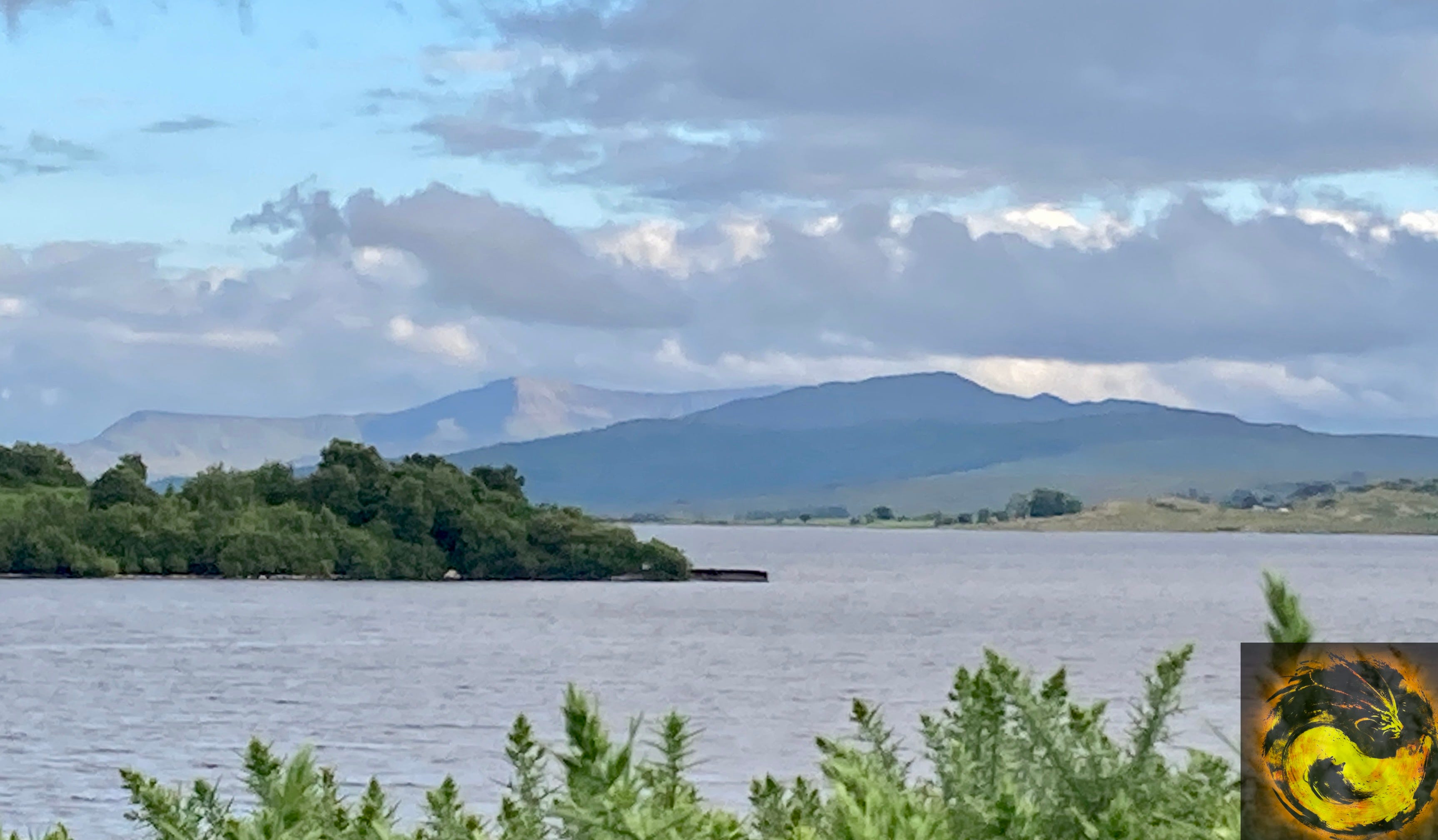
There is a mountain in the south of Gwynedd that will, if you spend the
night on its summit, do one of three things to you.
It will make you a poet.
It will make you mad.
Or it will not return you at all.
This is not a modern health and safety warning. This is the oldest story
they tell about Cadair Idris, and they have been telling it long enough
that nobody remembers when they started. The Welsh have a word — hiraeth
— for a longing so deep it has no object, a homesickness for somewhere
you have never been. Cadair Idris is where hiraeth lives. It is not a
comfortable mountain. It is a thinking mountain, a mountain that asks
questions and does not always wait for answers.
I am going to climb it.
Let us start with the name, because the name is where everything begins.
Cadair means chair. Seat. Throne. But dig a little deeper into the Welsh
root and something else surfaces: ca, to keep, to hold. The Chair of
Idris is also the Place of Control — the seat from which the
astronomer-giant held the heavens in view, mapped them, understood the
relationship between the sky above and the land beneath. A cadair is not
merely a place to sit. It is a place from which everything can be seen.
Idris — this is where it gets interesting.
The giant Idris ap Gwyddno is one of the three great astronomers of Welsh
legend, a figure so vast that he used the mountain as his observatory,
sitting in the hollow of the northern cwm to chart the stars above
Gwynedd. The legends describe a man of impossible learning — poet,
astronomer, philosopher, geographer — who understood the relationship
between the heavens and the land beneath them with a precision that
modern researchers are only beginning to take seriously.
But Idris has another identity, one that surfaces when you follow the
thread far enough back through the apocryphal literature.
Idris is Enoch.
Enoch appears briefly in Genesis — seven generations from Adam, father
of Methuselah, a man about whom the text says something it says about
almost nobody else: he walked with God, and he was not, for God took him.
No death. No burial. Simply — gone. The rabbinical and apocryphal
traditions elaborate extensively on what happened next: Enoch became
Metatron, the scribe of heaven, the keeper of the celestial records, the
one who walks the boundary between the human and the divine.
The keeper, in other words, of the star maps.
Hugh Evans — astrophysicist, aeronautical engineer, obsessive researcher
— has spent thousands of hours mapping what he believes is the largest
ancient site on Earth. The Star Maps of Gwynedd cover over two thousand
square miles, incorporating thousands of named stone circles, cairns,
standing stones, mountains, rivers, sacred sites and holy springs across
the northwest quarter of Wales. For context: the greater Stonehenge area
covers two hundred square miles. The Egyptian sites from Giza to Luxor
cover roughly four hundred. Gwynedd dwarfs them all — if Evans is right.
At the centre of this system: Cadair Idris. The constellation mapped onto
the mountain’s spectacular ridge is Ursa Major — The Plough, the most
recognisable star pattern in the northern sky, its bright stars
corresponding to the soaring peaks running west along the ridge. The Bear
sits upon the Chair.
And across the water, on the northern side of the Mawddach estuary, the
ancient rough country of the Rhinogydd maps to Draco — the dragon that
never sets, winding along its ridge, the constellation that circles the
celestial pole without ever dipping below the horizon. In the age when
these maps were laid down, before Polaris took over the job, Draco was
the fixed point around which the heavens revolved. Every ancient
astronomer from Babylon to Britain used it as their reference.
The Mawddach runs between them. One of the most dramatic estuaries in
Britain — running east-west, the light on it at certain times of day
being almost hallucinatory — separating the Bear from the Dragon, Cadair
from the Rhinogydd, Ursa Major from Draco.
I have walked beside that estuary hundreds of times. I did not know I
was walking the boundary between constellations.
The connection between Idris and Enoch is not Evans’ invention — it
surfaces in the Book of Enoch itself, which places the location where
Enoch received instruction from the angel Uriel to chart the heavens in
Gwynedd, at the latitude of Cadair Idris, approximately five thousand
years before the common era. Ancient British mythology confirms it
independently. The traditions converged on the same mountain from
different directions and different centuries and arrived at the same
answer.
This is how ideas travel. Not through a single unbroken line of
transmission, but through convergence — the same truth arriving from
different directions because the landscape itself holds the evidence.
I live twenty miles north of Cadair Idris. I have walked past it and
around it and on it for thirty years. I thought I knew what it was.
There is a tradition in Daoist thought — and I find myself returning to
it constantly — of the correspondence between the human body and the
landscape, between the small world and the large one. The mountain is
not a metaphor for the self. The mountain is a self, in the same way
that the self is a landscape. You do not conquer a mountain in this
understanding. You enter into a relationship with it.
I had a stroke in 2018. A cerebellar stroke — the cerebellum handles
balance and coordination and the automatic skills that your body learns
so deeply they stop feeling like skills at all. The things you do without
thinking. The things a mountain guide does without thinking.
I am going to climb Cadair Idris. Specifically, I am going to climb
Cyfrwy Arete — a Grade 3S* scramble on the northern face, technical,
committing, the kind of ground that asks everything of you and gives
everything back. I dreamed it a few weeks ago and woke with the question
still present: could I?
The Chair of the Astronomer. The Seat of Control. The place where the
Bear sits above the estuary and the Dragon winds along the ridge
opposite, and the water runs between them catching the light.
I am not a mystic. I am a mountain leader with a stroke history, a degree
in progress, a climbing partner named Aled who said yes enthusiastically,
and a habit of reading widely and finding that the world becomes more
interesting the more carefully you look at it, not less.
Both of these things are true at the same time. The mountain does not
care which one leads.
It simply waits.
This article was researched and drafted collaboratively with Claude
(Anthropic). The ideas, the geography, and the story are Jameson Selby’s.
The writing was shaped together.
The full story of the attempt on Cyfrwy Arete — the training, the
preparation, the academic project running alongside it — lives at
Gwella. Here Be Dragons is where the wider world gets
reported from: the water, the practice, the books, the dragons. Both
sites are part of the same thing. Neither is the whole story